
Because there are variables beyond my control (clays, papers, water, mixing errors and etc) always pre test fire what you have before a big project. No guarantee can be offered that 'alternative" commercial paperclays now on the market will meet the all the performance advantages of my high performance trademark P'Clay® brand only available from licensed manufacturers/distributors.
 | ceramicArts | clayStudioFAQ| kids | events | new book |
 | P'Clay®/P'Slip | sitemap | rosettegault
1:47
Inside Paperclay
Rosettes Vision
animated hypothesis
A Minute Plus
 research areas
Ongoing R&D Need for Refinement of Sustainable Materials
Applications Beyond Art
Low cost medicines can be extracted from nano-porous compounds of paperclay ceramic. Design advantage saves money and time in production. Learn More.

.
Let's Stay in Touch
Research: Vision :
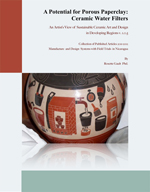
A Potential for Paperclay Water Filters: An Artist’s View
By Rosette Gault M.F. A. and Phd
Abstract
The potential for porous ceramic paperclay to lower costs of domestic water filtration in developing countries is discussed, with an artist’s view toward filters that are as easy to use, and to look at, as they are multi-purpose and eco-friendly.
Will a change in burnout material in pot ceramic water filters save money if reclaimed paper is used? A paperclay process has the potential to trim the production time and could, in due course, reduce airborne dusts, noise, power, and carbon fuel use. Also, a paperclay system allows ways to design and produce filters in developing regions that have not been technically feasible or practical with traditional ceramic.
In 2006, at a Filtron factory in Nicaragua, paperclay water filter pots of local terra cotta clay and pulp from recycled Managua newspaper were tested in production. Best practices for ceramic filter manufacture in developing regions are discussed within the context of improvements that the paperclay methods have potential to offer.
Ways that the pulp making reclaim process can be set up and complement the pot manufacture process are shown. Practical directions for further research, art, and design for a sustainable society will be discussed.
_____________
Contents of the Collection above
Long paper instruduced at International Symposium: Ceramic Art Design and Systainability Symposium in Gothenberg, Sweden March 7, 2011
Included also a series of shorter articles that followed report published in issues of Ceramics Art and Perception: Technical (an international journal) May 2011, Fall 2011 and May 2012.
The design challenge in context of the global variables, economic development, the local materials, the field study in Nicaragua with Ron Rivera, production, practical aspects of manufacture and applied design, sustainable materials.
Display at Seattle Tacoma International Airport Concourse A Gate One - some models- for potters and handbuilders- low tech fast hand making is possible with the most simple local materials. March-July 2012 was seen by international travelers.
